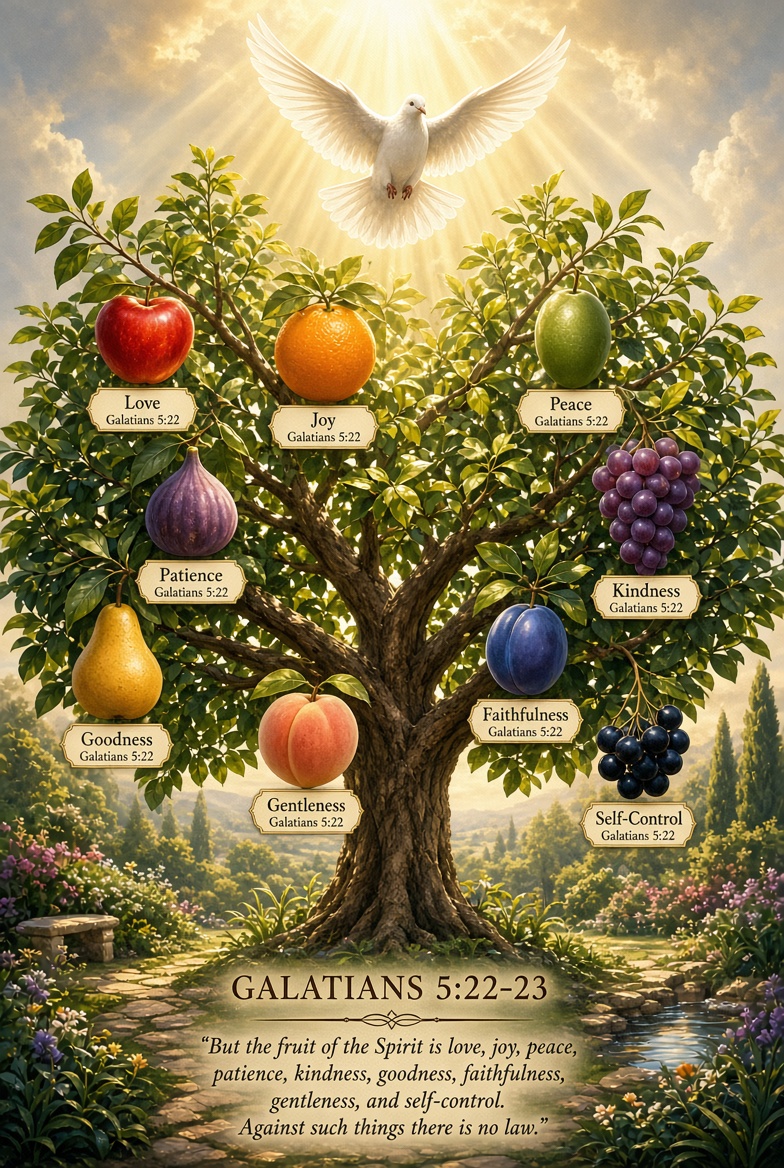
In Galatians Chapter 5, following the listing and condemnation of the works of the flesh, the apostle Paul by inspiration gives positive instruction on how Christians should conduct themselves; namely adopting and demonstrating the fruit of the Spirit. Galatians 5:22-23 reads “But the fruit of the Spirit is love, joy, peace, longsuffering, gentleness, goodness, faith, meekness, temperance: against such there is no law”. While the works of the flesh are forbidden by the law of God there is no such prohibition against the works of the Spirit. In fact, immediately following in verses 24 and 25 the scripture says “And they that are Christ’s have crucified the flesh with the affections and lusts. If we live in the Spirit, let us also walk in the Spirit”. From these we conclude that this is how God expects us to live and will therefore carefully define each attribute in the following narrative.
The word fruit is singular in the text indicating that these attributes are not pick and choose but rather represent a complete way of living. One author has likened this understanding to an orange where the total fruit is made up of many segments (Charles Horner, “Galatians Notes”, WVBS, p: 52). This we believe gives an accurate picture. It is further noted below that the word fruit has a root which means to be caught up (Acts 8:39) as in moving on to another place. Though one cannot be certain of this application, living according to the fruit of the Spirit certainly takes us from a flesh serving life to a spiritual life. The complete definitions, as presented by Jay P. Green Sr., “The New Englishman’s Greek Concordance and Lexicon”, Peabody, Massachusetts, Hendrickson Publishers, 1982, are as follows:
Fruit, kαρπος, is defined literally as fruit (Mark 11:14) and figuratively as a result or outcome, (Ephesians 5:9; Hebrews 12:11). The root of the word is αρπαζω meaning in a spiritual sense to be caught up, (2 Cor. 12:2; Acts 8:39). The word is used 66 times in the KJV New Testament and is translated fruit 54 times (e.g. Mark 11:14) and fruits 12 times (e.g. 2 Timothy 2:6).
Love, αγαπη, is defined as love, esteem: used of the supreme Christian virtue, (1 Corinthians 13); of God to men, (Romans 5:8); of men toward God, (1 John 2:5); of men toward men, (John 13:35); and in the plural of love feasts, defined as a meal exemplifying fellowship, (Jude12). The root of the word is αγαπαω, used to express a virtuous and selfless Christian love. The word is used 116 times in the KJV New Testament and is translated love 84 times (e.g. Romans 8:39) and charity 28 times (e.g. 1 Corinthians 13:13); and one time each as: charitably, (Romans 14:15); dear, (Col 1:13); love’s (Philemon 1:9); and loved (Ephesians 5:2).
Joy, χαρα, is literally defined as joy in (Matthew 13:44; Mark 4:16), and by metonymy for that which causes joy (Philippians 4:1; Hebrews 12:2). The root of the word is χαιρω, to rejoice or be glad (Mark 14:11; John 4:36). The word is used 59 times in the KJV New Testament and is translated joy 51 times (e.g. Romans 14:17), gladness 3 times (e.g., Acts 12:14) and one time each as: greatly (John 3:29), joyful (2 Corinthians 7:4), joyfully (Hebrews 10:34), joyfulness (Colossians 1:11) and joyous (Hebrews 12:11)
Peace, ειρηνη, means peace, tranquility, wellbeing, (Romans 1:7; 3:17). The word is used 92 times in the KJV New Testament and is translated peace 89 times (e.g., Titus 1:4) and one time each as again, one (Acts 7:26), quietness (Acts 24:2), and rest (Acts 9:31)
Longsuffering, μακροθυμια, is defined as forbearance, longsuffering, patience, endurance, (Romans 2:4; Hebrews 6:12). This is a compound word rooted in μακρος, meaning long in time or distance and θυμοω, passion, anger, wrath. The word is used 14 times in the KJV New Testament and is translated longsuffering 12 times (e.g., Ephesians 4:2) and twice as patience (e.g., James 5:10).
Gentleness, χρηστοτης, is defined as uprightness, integrity, (Romans 3:12); kindness, (Romans 2:4, 2 Corinthians 6:6, Titus 3:4). The root of the word is χρηστης, meaning of things: good or fit for use; of people: kind, benevolent; of God: gracious. The word is used 10 times in the KJV New Testament and is translated 4 times each as goodness (e.g. Romans 11:22) and kindness (e.g. Colossians 3:12) and once each as gentleness (Galatians 5:22) and good (Romans 3:12).
Goodness, αγαθωσυνη, is defined as goodness (Romans 15:14; Ephesians 5:19; Galatians 5:22). The root of the word is αγαθος, meaning good either physical or moral, benevolent as opposed to evil. Divine advantage. Good things whether possessions of deeds. The word is used 4 times in the KJV New Testament and is always translated as goodness (e.g. 2 Thessalonians 1:11).
Faith, πιστις, is defined as faith, total trust in God, (Matthew 8:10; Romans 3:22); faithfulness (Romans 3:3) and the faith (Romans 1:5). The root of the word is πειθω meaning to convince or persuade, conciliate or satisfy. The word is used 244 times in the KJV New Testament and is translated faith 239 times (e.g., Acts 20:21) and one time each as assurance (Acts 17:31), belief (2 Thessalonians 2:13), believe (Hebrews 10:39), believeth (Romans 3:26) and fidelity (Titus 2:10)
Meekness, πραοτης, is defined as meekness (1 Corinthians 4:21; 2 Corinthians 10:1). The root of the word is πραος, meaning meek, gentle, humble. The word is used 9 times in the KJV New Testament and is always translated meekness (e.g. Colossians 3:12).
Temperance, εγκρατεια, is defined as self-control (Acts 24:25; Galatians 5:23; 2 Peter 1:6). The root of the word is εγκρατης, meaning strong, masterful, self-controlled, disciplined. The word is used 4 times in the KJV New Testament and is always translated temperance (e.g. 2 Peter 1:6).
From these words we see a life that is a blessing not only to ourselves but others. We see a calm and fulfilling life in service to our fellow man. We also see that these are not something that we just simply seize at their fullness on the first attempt. Rather we see that the attributes are such that they develop and become fuller and more complete as we walk the Christian walk. Ephesians 5:8-10 says it this way; “For ye were sometimes darkness, but now are ye light in the Lord: walk as children of light: (For the fruit of the Spirit is in all goodness and righteousness and truth;) Proving what is acceptable unto the Lord. 2 Peter 1:4-8 describes the Word and putting together spiritual segments; “Whereby are given unto us exceeding great and precious promises: that by these ye might be partakers of the divine nature, having escaped the corruption that is in the world through lust. And beside this, giving all diligence, add to your faith virtue; and to virtue knowledge; And to knowledge temperance; and to temperance patience; and to patience godliness; And to godliness brotherly kindness; and to brotherly kindness charity. For if these things be in you, and abound, they make you that ye shall neither be barren nor unfruitful in the knowledge of our Lord Jesus Christ”.
Let us go forth being neither barren nor unfruitful but rather living life in spiritual fulness.
How God Saves – – Keep the faith.